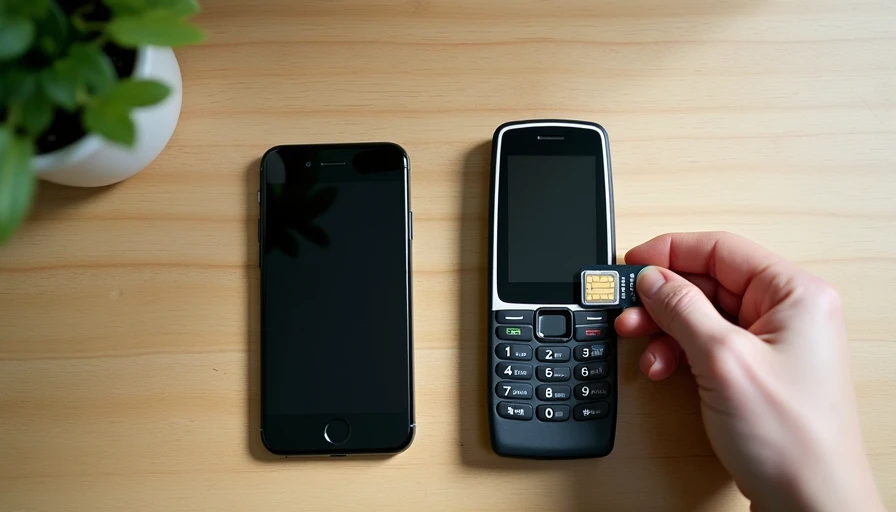
I bought a $90 Nokia 225. It has a T9 keypad, a 2.8-inch screen, and no app store.
My iPhone 15 Pro went into a drawer on Sunday night. I pulled the SIM card out, snapped it into the Nokia, and committed to seven days of dumbphone living.
No social media. No email on the go. No maps. No Uber. No camera that takes 48-megapixel portraits of my coffee. No endless scroll. No pull-to-refresh. No notifications—except for actual text messages and phone calls, which is what a phone was originally designed for.
Here's what happened.
Day 1–2: The Panic
The first day was uncomfortable in ways I didn't expect.
I reached for my pocket about 40 times to check something—anything. News. Weather. My email inbox. The same email inbox I checked 20 minutes ago. Nothing was there. I knew nothing was there. I checked anyway.
The Nokia's screen is tiny. You can't browse the web on it—not really. You can load a WAP page if you have the patience of a monk. I did not. So I stopped checking.
And then something weird happened: I had nothing to do. I was standing in line at the grocery store. Usually, that's prime scrolling time. Instead, I looked at the produce. I read the labels on canned tomatoes. I noticed that the person in front of me had a very kind smile.
I was bored. And boredom, it turns out, is not the enemy. It's the prerequisite.
Day 3–4: The Quiet
By day three, the panic had faded. A quieter rhythm settled in.
I started noticing how much of my phone time was spent not on using my phone, but on checking it. There's a difference. Using is intentional—you want to look up a restaurant, message a friend, pay a bill. Checking is compulsive—you pull it out without thinking, unlock it, open an app, close it, put it back. That cycle takes maybe 30 seconds. I was doing it dozens of times a day.
On the Nokia, checking wasn't possible. There was nothing to check. So the cycle broke.
I started reading more. Not articles—actual books. Paper ones. I finished one in four days, which is faster than I'd read anything in months.
I started walking differently. Without a phone in my hand, my head came up. I noticed street names I'd never registered. I noticed how the light changed on the buildings as the afternoon wore on.
I started talking to people. Strangers, mostly. Brief exchanges—asking for directions, commenting on the weather, telling someone their dog was cute. Small things. But they happened because I wasn't hiding behind a screen.
Day 5–6: The Trade-offs
By the middle of the week, the trade-offs became undeniable.
I got lost. Twice. Without Google Maps, I had to ask strangers for directions. This was embarrassing and also completely fine. In both cases, the stranger was helpful. In one case, I had a pleasant conversation I would never have had if I'd just stared at a blue dot on a screen.
I couldn't take photos. The Nokia has a camera. It's terrible. I missed capturing some beautiful moments—the fog rolling over a hill, a friend's laugh at dinner, a sunset that made everything gold. I felt the loss. But I also noticed something: I remembered those moments more vividly. Without the reflex to document, I was actually present.
I was slower. Everything took longer. Meeting up with friends required pre-planning. Looking up a restaurant required calling them. Paying for parking required coins. The friction was real, and sometimes frustrating.
But the friction also forced me to be intentional. I couldn't just "figure it out on my phone." I had to decide what I wanted, commit to a plan, and execute it. That clarity was surprisingly freeing.

Day 7: The Return
On the seventh evening, I took the SIM card out of the Nokia and put it back in my iPhone.
It felt heavier than I remembered. Heavier in my hand. Heavier on my mind.
I opened the App Store and scrolled through all the apps I'd ignored all week. News apps. Social apps. Shopping apps. Games. Calendar. Email. Two-factor authentication. Weather. Banking. Health tracking. Music streaming. Podcasts. Maps. Photos. Notes. Mail. Messaging. I had three full screens of them.
I didn't miss most of them.
I turned the phone back on. It lit up with a dozen notifications. Emails. News headlines. A reminder to "start my day with intention." An alert that someone had liked a tweet I posted a week ago. A push from a game I'd forgotten I installed.
I looked at that screen and felt something I hadn't felt in a while: overwhelmed.
What I Kept
I didn't throw my iPhone away. That's not the point.
But I did keep a few things from that week:
The habit of not checking. I no longer pull out my phone when I'm waiting. I just wait. It's fine.
The deliberate use. I ask myself before I open an app: "Is this intentional or compulsive?" More often now, I put the phone back down.
The grayscale mode. I'd done grayscale before, but after the dumbphone week, it felt different. Not like a limitation—like a preference.
The reading. I kept reading paper books. They don't need charging and they never ping you.
What I Gave Back
I gave back the illusion that I need access to everything, all the time, at every moment.
I gave back the reflex to document instead of experience.
I gave back the anxiety of being "out of touch." I found that the people who needed me could still reach me—by calling. The rest could wait. And they did.
I gave back the belief that my phone is essential for my daily functioning. It is not. It's a tool, and I had been treating it like an organ.
Do You Actually Need a Dumbphone?
Probably not. But you might need a dumber relationship with your smartphone.
The week was an experiment, not a lifestyle. I'm not selling you on a Nokia. I'm not telling you to go back to T9 texting—I'm a designer, and I can't pretend I didn't miss the keyboard.
But I am telling you this:
The phone is not the problem. The default settings are.
If you turn off notifications, delete the social apps, switch to grayscale, and put your phone in another room for an hour a day—you've already gotten 90% of what I got from a week with the Nokia. You don't need to buy anything. You just need to change the defaults.
You need less than you think. Sometimes the best feature of a phone is the one you choose not to use