The problem with a phone as an alarm clock was never whether it could ring.
I spent eight years designing consumer apps. I know the alarm feature was never just an alarm — it's the bridge between "one last look before sleep" and "the first thing you see when you wake up." I've written the kind of interface logic that gets you to scroll for five more minutes right after you've already silenced the alarm.
So when I decided my phone wasn't allowed in the bedroom anymore, I needed a clock. Not a "smart" one. Not something that syncs my calendar, plays white noise, and hands me a sleep score in the morning. Just something that rings and tells me the time.
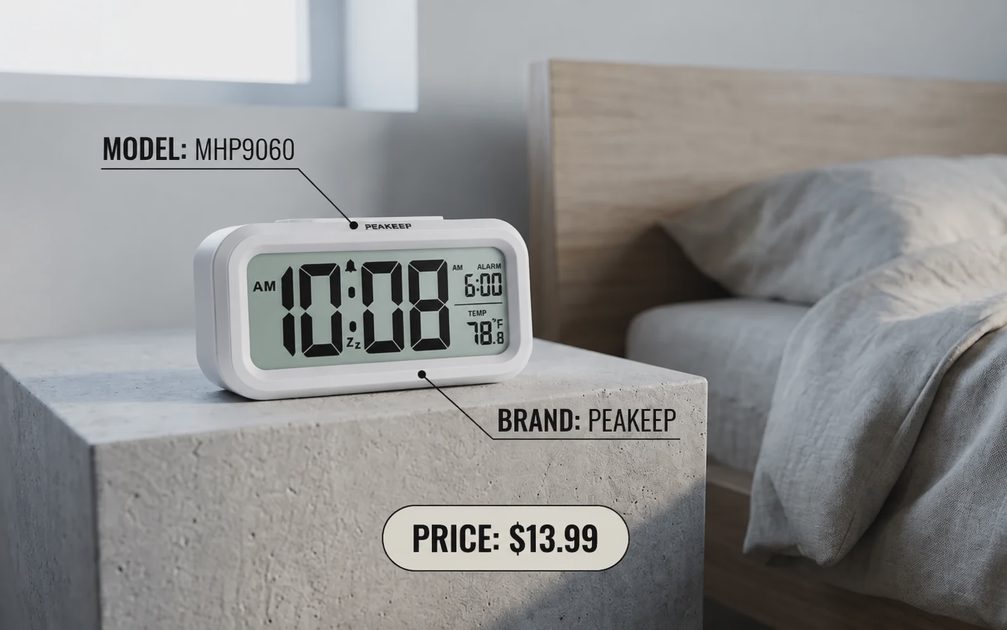
I paid $13.99 for a Peakeep — the MHP9060, their base model.
Buying it was easy
No outlet required. Three AAA batteries, set it on the nightstand, done. No hunting for a socket, no deciding where the cord goes. Anyone who's ever dug through a hotel nightstand at midnight looking for a free plug knows exactly why this matters. Pack the clock for a camping trip and it comes straight off the nightstand and into your bag. It doesn't care where you put it.
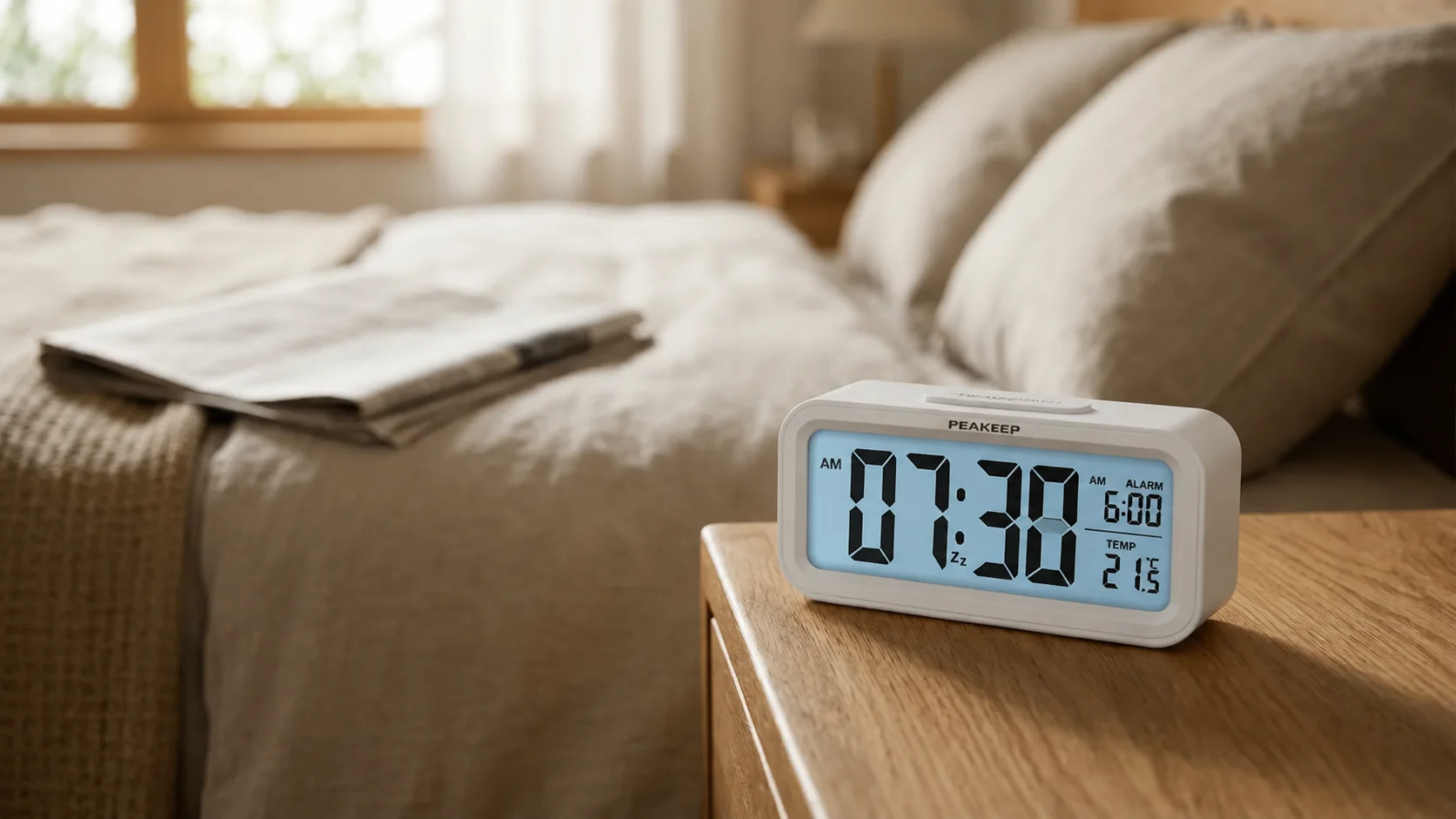
Readable without your glasses. The LCD screen has digits large enough to read from across the room, and switches between 12-hour and 24-hour formats.
A night light that doesn't cost you your attention. Three settings — low, high, off — so you can check the time in the dark without touching your phone. And the second your phone lights up, you've already lost: that glow is a doorway to every notification queued up behind it.
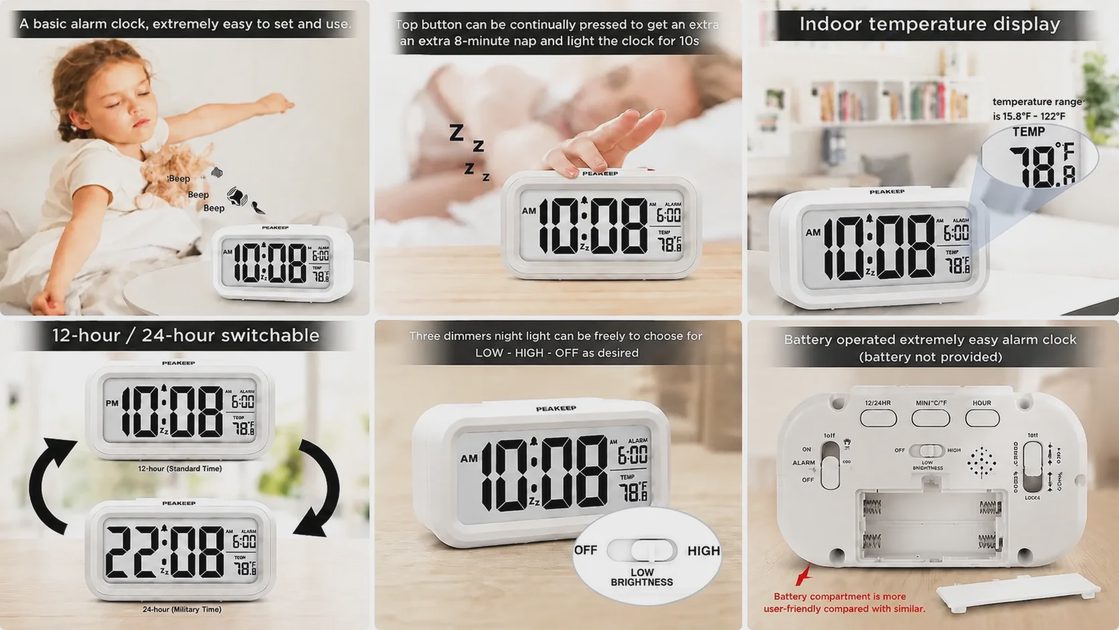
A reason to get up, not just a gadget. It shows the room temperature, switchable between °F and °C. I thought this was pointless at first. A week in, I noticed I was checking it every morning before I even got out from under the covers. Knowing how cold it is outside turns out to be a better reason to get up than I expected.
An alarm that wakes you up instead of assaulting you. It builds gradually — quiet at first, slowly getting louder. If you're used to being jolted awake, this might feel too gentle. But I've woken up to my phone's loudest, most seismic alarm setting, and that's not "waking up." That's being attacked. There's a dial on the back labeled "SNOOZE/LIGHT" — flick it up and you snooze, exactly as direct as any alarm clock should be.
Small enough to disappear. It's a bit smaller than the palm of your hand — 5.25 inches wide, 3 inches tall — and doesn't take up any real estate on the nightstand. The shell is the kind of lightweight plastic you'd expect from something made in China; it doesn't feel premium in your hand. But then again, a $13.99 alarm clock doesn't need to feel premium. It needs to stay out of your way.
Product Specifications: Peakeep MH-9060 Alarm Clock
Attribute | Details |
|---|---|
Brand / Model | Peakeep MH-9060 (White) |
Display Type | Digital LCD with indoor temperature display |
Power Source | Battery-powered (3 x AAA batteries) |
Dimensions | 5.25 x 3 inches |
Weight | 186 grams |
Color / Design | White, rectangular, modern style |
Suitable Rooms | Bedroom, dining room, home office, kids' room, living room |
Manufacturer Warranty | 90 days |
What it doesn't do matters more than what it does
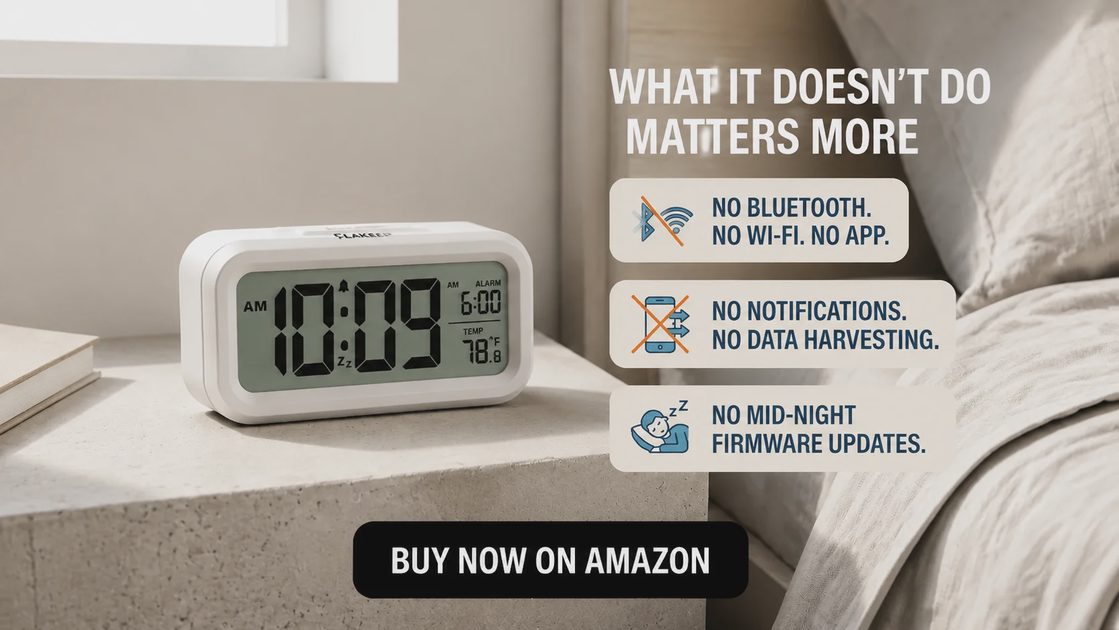
No Bluetooth. No Wi-Fi. No app. Nothing to pair. No notifications. It doesn't push anything to you. It doesn't learn your sleep habits. It doesn't send you a report. It doesn't light up in the middle of the night because of a system update.
It's a screen that shows the time and the temperature. Plus an alarm that rings.
I should be honest about two things it doesn't do well. It drifts a bit over a few weeks — a couple of button presses fixes it, but it's not quite "set it and forget it." And the auto-dimming light sensor is one of the more fragile parts; a handful of owners report it stops sensing ambient light after a few days. Manual dimming still works fine either way.
Do you know how rare "did nothing" is in today's product landscape? Every product is racing to add itself onto more of your life — until you can't tell anymore whether it's an alarm clock or a speaker or a health coach or something else entirely. Addition is always easier than subtraction. Subtraction requires restraint. It requires saying no. It requires being okay with "not enough features."
This clock does almost nothing. That's exactly why it gets everything right.
A device either makes decisions for you, or it keeps asking you to make them. There's no middle ground.
The clock has exactly one interaction worth mentioning: that "SNOOZE/LIGHT" dial on the back. Press the top, or press almost anywhere on the back, and the screen lights up for ten seconds. That's it. No app, no pairing, no account, no firmware update nagging you on a Tuesday. The whole point of the object is legible in about four seconds of holding it.
That's not a small thing. A phone is a bad alarm clock not because the alarm part fails, but because the object is also a doorway to everything else you own. Peakeep can't be anything other than what it is. That's the actual feature.
So do you actually need this?
If your phone never makes it into bed with you — you've already won. You don't need to buy anything.
If you already have a simple, working alarm clock, you don't need to replace it just because this one has a better review count. And if you're a genuinely light sleeper, sensitive to any light at all, the night light is a real drawback, not a nitpick — think that through before you buy.
If the "alarm clock" on your nightstand right now is your phone — face down, do-not-disturb on, and still somehow pulling your attention back the second you glance at it for the time — then yes, you need this. This $13.99 rectangle solves that exact problem, for less than the cost of dinner out.
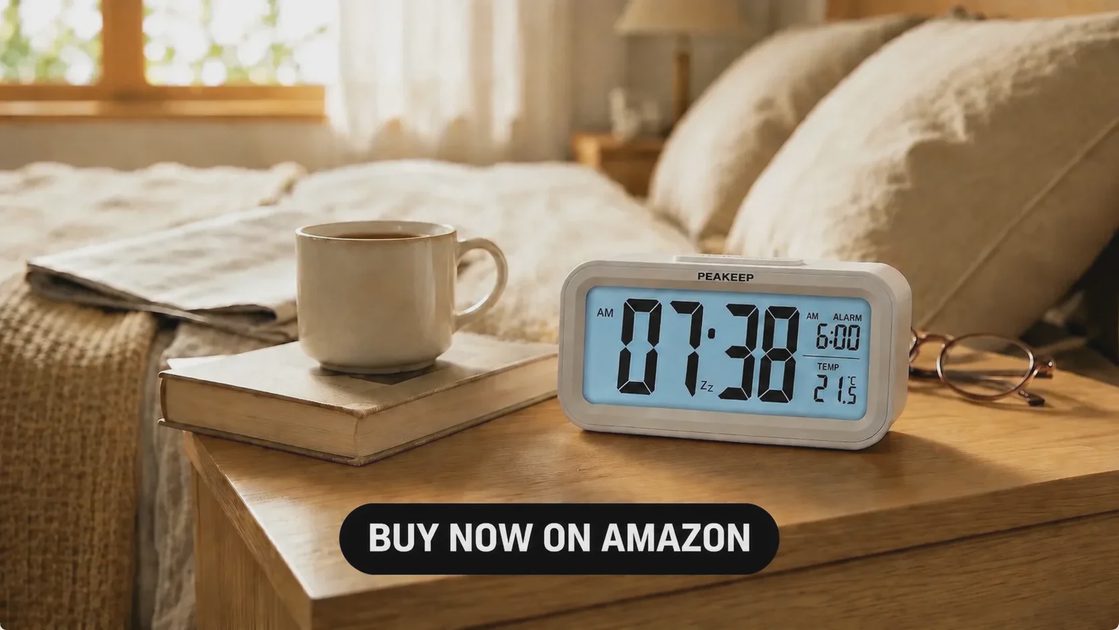
It won't get you scrolling for twenty extra minutes. It won't push you anything. It won't use infinite scroll to keep you there. It won't show you a feed the moment you silence the alarm. It's a quiet, single-purpose object that sits on your nightstand, wakes you up, and then shuts up. An alarm clock doesn't need to be smart. It just needs to do what an alarm clock is supposed to do.
You need less than you think. One dial you can understand with a twist beats ten layers of menu.