An illusory correlation example: You notice that a stressful workday often ends with an evening of scrolling, so you conclude that scrolling causes every bad night's sleep. The connection feels obvious because those nights stand out. But unless you also notice stressful days without scrolling and scrolling nights when you sleep fine, you don't know how strong the relationship is—or whether scrolling is the cause.
An illusory correlation is a perceived relationship between two things that are unrelated or less strongly related than you believe. It's not a sign that you're irrational. It's what can happen when memorable moments get more attention than ordinary ones.
A simple illusory correlation example with notifications
Imagine you think checking notifications makes you miss important messages. You remember opening your phone to find a dozen minor updates and, later, discovering a time-sensitive email you overlooked. After a few frustrating days like that, the two events start to feel inseparable.
There may be a real connection: interruptions can compete for your attention. But your memory of a few conspicuous misses can't tell you how often it happens. Maybe you also miss messages on quiet days. Maybe the urgent emails arrive in a different inbox. Maybe the apparent pattern is real, but weaker than you think.
To check it, look at four combinations: notification-heavy days with a missed message, notification-heavy days without one, quiet days with a miss, and quiet days without one. Those uneventful days matter just as much as the irritating ones.
Here's a made-up comparison. Suppose you miss an important message on two of ten notification-heavy days and two of ten quiet days. In that little sample, a miss was equally common in both groups. The memorable pairings might still feel meaningful, but the numbers don't support a connection. A longer observation could look different.
Why the pattern feels so convincing
An illusory correlation example usually has two ingredients: events you can recognize easily and a reason to remember them together. A late-night scroll followed by a rough morning gives you a tidy story. A late-night scroll followed by an ordinary morning doesn't offer much of a story at all.
Attention interfaces can make the memorable moments more visible. A red badge highlights an unread item; a banner interrupts whatever you're doing. Those design choices don't create an illusory correlation by themselves, but they can direct your attention toward particular events while the less dramatic alternatives pass unnoticed.
I think this distinction matters. You don't need to prove a psychological bias before deciding that a notification setting is annoying. You can change a setting because you prefer fewer interruptions. The caution is against turning a preference into a confident claim about what always causes your worst days.
How to check an illusory correlation example
Start by making the claim small enough to observe. Instead of “my phone ruins my sleep,” try “on work nights when I use social media in bed, I take longer to fall asleep.” Then decide what counts as using it in bed and how you'll record your estimate of time to sleep.
For a week or two, make a brief note each morning: whether you scrolled in bed and roughly how long it felt like you took to fall asleep. Record both kinds of night, including the nights that don't fit your expectation. A calendar mark or a note on paper is enough; you don't need another dashboard.
At the end, compare the two groups rather than counting only the nights that support your hunch. A handful of observations won't establish a reliable rule, especially when bedtime, caffeine, stress, and other factors vary. It can still show you whether your initial certainty deserves a second look.
If you want to explore a possible cause, try changing one thing for a few nights: leave social media out of bed while keeping your usual wind-down as similar as practical. Notice how you feel, then compare. That's a personal experiment, not proof that the same change will work for everyone. If sleep problems persist or affect daily life, consider talking with a health professional.
Correlation, causation, and coincidence
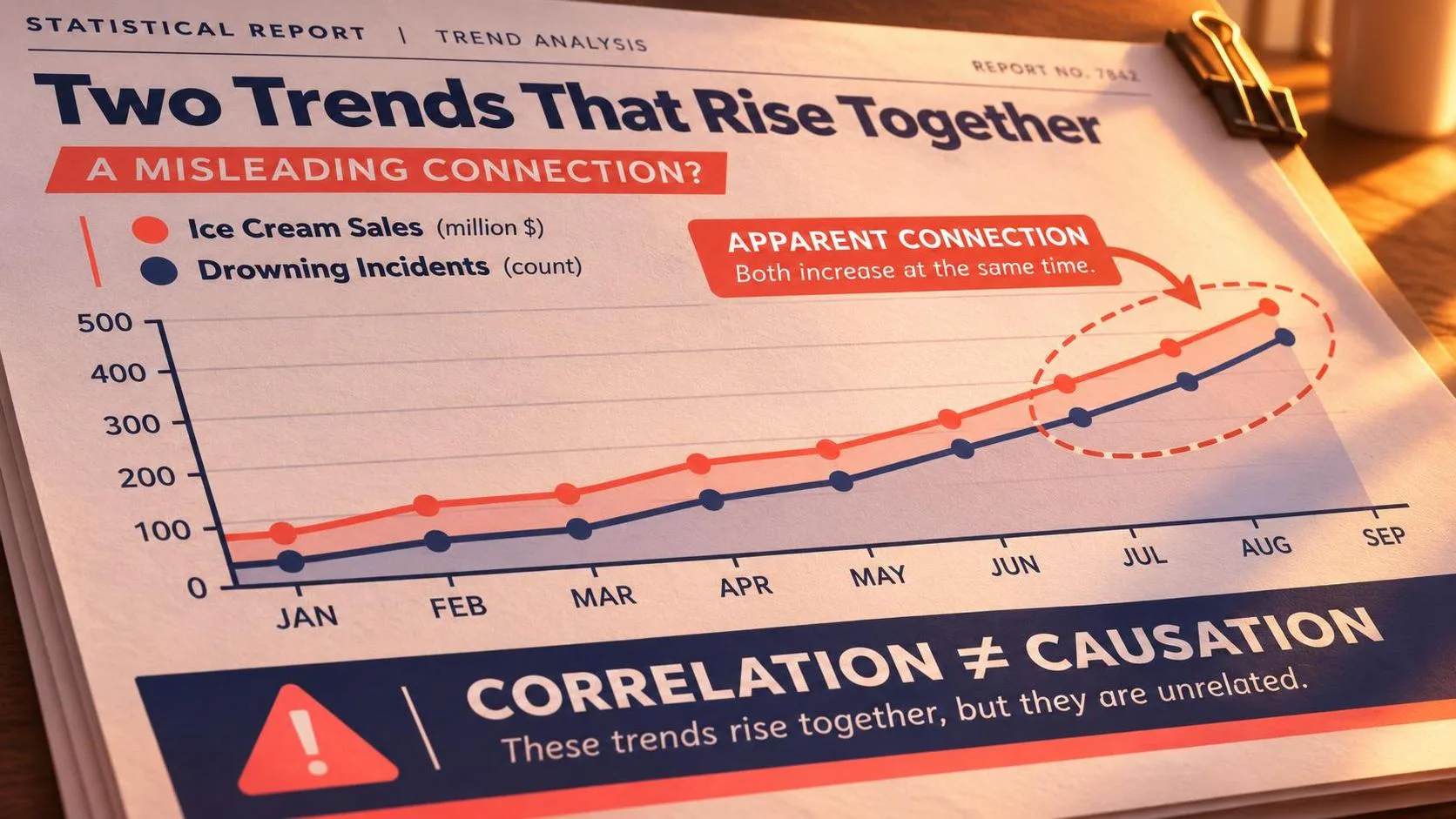
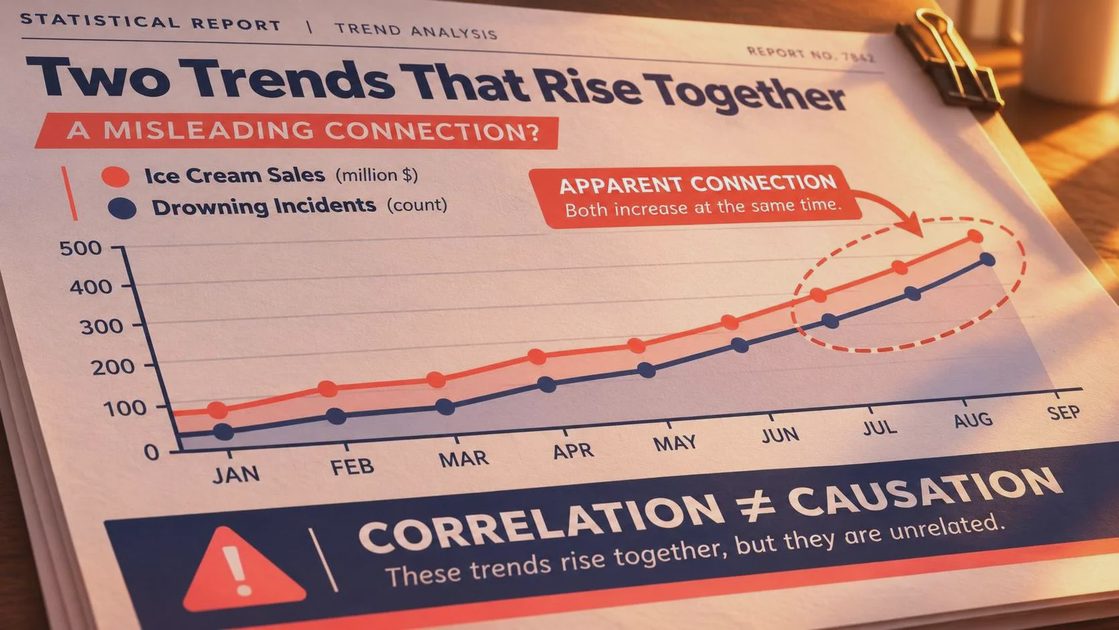
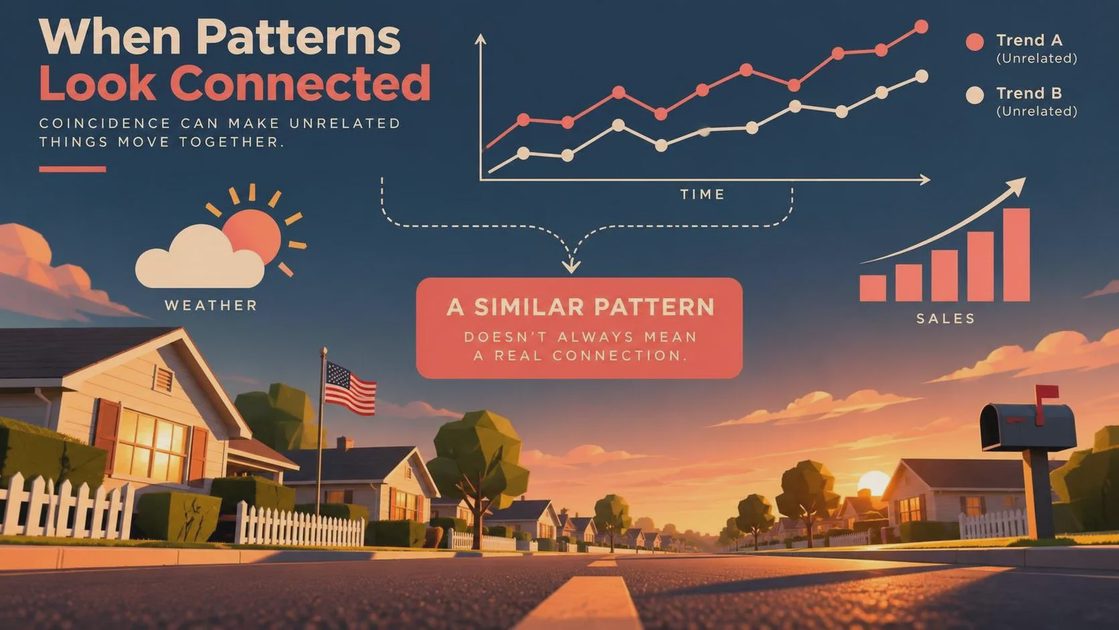
This distinction is easy to blur. Correlation means two things vary together; it does not, on its own, establish that one causes the other. An illusory correlation goes a step earlier: the relationship you think you're seeing may not be there, or may be smaller than it feels.
For another illusory correlation example, consider a designer who remembers that a new productivity tool was followed by a good workday. The tool may have helped. The day may also have been lighter on meetings, or the designer may have been especially motivated to finish a project. And there may have been plenty of good days without the tool.
A coincidence can produce a convincing story without a meaningful relationship. A real relationship can also exist without the cause you assume. These are different possibilities, so it's worth asking two separate questions: Do the events actually occur together more often? If they do, what else could explain that?
What to do with the insight
The goal isn't to distrust every instinct or turn your life into a research project. It's to give a persistent story a fair hearing. If you believe a gadget makes you productive, notice the days you use it and still struggle, as well as the days you do good work without it. If you believe a particular app always leaves you drained, notice when it doesn't—and whether the activities inside it differ.
An illusory correlation example is useful because it exposes the observations we tend to leave out. I'd keep one habit: when a pattern feels certain, ask what the unremarkable counterexamples look like. You need less than you think, including less certainty about a story built from a few memorable days.