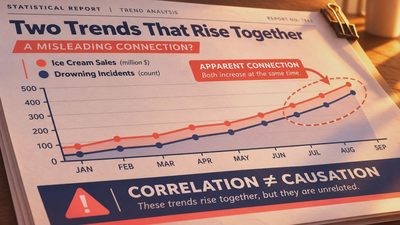

Illusory correlation examples show how easily we can connect two things that aren’t actually related, or exaggerate a connection that is much weaker than it feels. Think of checking your phone and finding an important message: after a few memorable hits, it can feel as though checking often helps you catch things at just the right time. The quiet checks when nothing important appears are easier to forget.
That doesn’t mean every pattern you notice is imaginary. It means the moments that stand out aren’t always a representative sample. The useful question is: What happened the rest of the time?
How an illusory correlation works
An illusory correlation is a perceived relationship between two events or characteristics that is nonexistent or weaker than we believe. You notice A and B occurring together, then give those moments more weight than the times they don’t.
Some illusory correlation examples begin with two unusual events. If a rare app outage happens on a day you changed a setting, the coincidence may feel meaningful precisely because both events stand out. But the outage could have happened independently of your change. A sequence isn’t, by itself, evidence of a cause.
The same bias can reinforce stereotypes. When someone expects a group to behave a certain way, examples that fit the expectation may be more memorable than examples that don’t. That can make an unfair belief feel supported by experience even when the full picture tells a different story.
There’s a difference between this and confirmation bias. Confirmation bias is the broader tendency to favor information that supports an existing belief. Illusory correlation is specifically about perceiving a relationship between things. The two can work together: a belief directs your attention, and the selective evidence makes the relationship seem real.

Illusory correlation examples in digital life
These illustrations aren’t evidence that a particular app causes a particular behavior. They show how a plausible story can form before we’ve checked the less memorable cases.
Checking your phone and catching important messages
You open your phone during a break and see a time-sensitive message. The timing feels almost predictive: good thing you checked. After several moments like that, you may conclude that frequent checking is necessary.
But how often did you check and find nothing urgent? And how often did an important message arrive when you weren’t looking, with no consequence? Those missing observations matter. Some jobs really do require quick responses; the point is to check the expectation rather than assume every notification deserves the same urgency.
A new productivity app and a good week
You install a task manager on Monday and finish a major project by Friday. It’s tempting to credit the new app. Maybe it helped you see the work more clearly. Or maybe the deadline was close, the project was already underway, or a meeting was canceled.
A calmer test is to ask what changed besides the app and whether the benefit lasts across different kinds of weeks. You don’t need a perfect experiment to notice that a tool takes 20 minutes a day to maintain but rarely helps you decide what to do next.
Bad sleep and an evening screen
You use your phone before bed and sleep poorly. That pairing is worth noticing, especially if it repeats. But one rough night doesn’t establish that the phone caused it. Stress, caffeine, noise, and an irregular bedtime are among the other things that could matter.
Try comparing several evenings with different phone habits while noting other relevant changes. Treat the result as personal information, not a medical diagnosis. Persistent sleep problems deserve a conversation with a qualified clinician.

How to check whether the relationship is real
The most useful illusory correlation examples make the missing evidence visible. Imagine you think opening a social app during lunch makes your afternoon less focused. Before changing anything, define what you mean by focused: perhaps whether you complete a planned work block without switching tasks.
For a couple of weeks, make a small note on workdays: did you open the app at lunch, and did you complete the planned block? You’ll have four kinds of days to compare: app and completed block, app and no completed block, no app and completed block, and no app and no completed block.
Compare the proportion of completed blocks on app days with the proportion on non-app days. For example, if you completed the block on three of five app days and three of five non-app days, this tiny sample doesn’t suggest a difference. Those numbers are an illustration, not a claim about anyone’s habits.
Even a clearer difference wouldn’t prove the app caused it. You might open it more often on stressful days, and stress might also make focus harder. If you want to explore further, choose in advance which days you’ll skip the app, keep the work block as consistent as practical, and see what changes. A short personal check can guide a choice; it can’t settle a broad scientific question.
When the pattern involves other people
Illusory correlation examples become more consequential when they shape how we judge colleagues, neighbors, or strangers. If you expect a particular group to be unreliable, one missed deadline might stick in your mind while many met deadlines pass unnoticed. The belief can influence hiring, trust, and who gets the benefit of the doubt.
Slow down the claim. Ask whether you’re remembering every comparable case or only the vivid ones, and whether the group label is relevant to the behavior at all. For a workplace decision, use the same clear criteria for everyone rather than relying on a gut feeling about a category of people.
What I’d keep
You don’t need to track every habit or turn your life into a spreadsheet. I’d keep one question handy: “What am I not counting?” It creates enough space between a striking moment and the story you attach to it.
If a notification seems essential, look at the uneventful checks. If a tool seems magical, look at what else changed. You need less than you think, including less certainty about the first explanation that comes to mind.