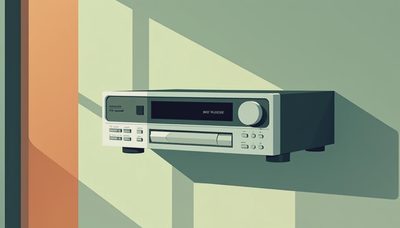
Do you actually need a muji cd player? That is the useful question, because this is not really a compact stereo competing with a Sonos Era 100 or a Bose SoundLink. It is a physical invitation to play one album, sit down, and stop making choices. I spent several evenings with one near my desk, where my phone usually controls music, podcasts, messages, and the next distraction.
The appeal is immediate. A CD goes in, the large front panel opens, and the music begins without an account, recommendation feed, Bluetooth pairing ritual, or glowing rectangle asking whether I want to enable notifications. The experience feels closer to putting a record on than opening Spotify, though the hardware is lighter and less luxurious than its calm industrial design suggests.
What the muji cd player gets right
The design is deliberately simple. A white rectangular body, a vertical disc compartment, a pull cord, and a few physical controls do nearly everything. The cord is the power switch: pull it once to start playback and again to stop. That small gesture is more satisfying than it sounds. There is no startup animation, no home screen, and no tiny menu buried behind a capacitive button.
This simplicity changes the shape of listening. With streaming, I often begin with a specific album and end up reading an artist biography, checking a playlist, or opening email. The muji cd player creates a closed loop. You choose the disc, press play, and accept the sequence that is already there. For people trying to build a calmer desk, that constraint is the product rather than a limitation.
Sound quality is competent for a small room. The built-in speaker is clear enough for background listening, spoken audio, and moderate-volume albums. It does not deliver deep bass or a wide stereo image, and the thin enclosure becomes obvious when you push the volume. I would not use it as a primary living-room system. With headphones or an external connection, however, the character becomes less important than the freedom from phone-based playback.
The quiet cost of physical media
A muji cd player only makes sense if you still own CDs or genuinely want to build a small collection. Used discs are often inexpensive at record stores, library sales, and online marketplaces. You can find familiar albums for roughly $3 to $12, while new releases and special editions can cost $15 to $35. That is not automatically cheaper than a streaming subscription, but it changes your relationship with ownership.
A CD also has edges. You need to store it, keep it clean, and remember which album you bought. If you work from a laptop and want uninterrupted background music for six hours, changing discs becomes a minor chore. The device will not instantly surface an obscure ambient mix for a focused afternoon. It offers fewer options because it has fewer options.
That trade is useful when choice itself is tiring. I noticed that I listened more closely to records I had chosen in advance. I also stopped skipping tracks after the first thirty seconds. The physical format introduced enough friction to make me stay with an album, without requiring a dramatic digital detox or a phone locked in another room.
How it compares with modern alternatives
A small Bluetooth speaker is the more practical purchase for most households. A JBL Flip 6 is portable, durable, and usually sells in the neighborhood of $100. A Sonos Era 100 costs more, but it produces fuller sound and fits into a multi-room setup. Both can play nearly anything from a phone, which is exactly why neither creates the same boundary.
A portable CD player with headphones is another route. It costs less and is easier to carry, but it lacks the satisfying physical presence of a dedicated object on a shelf. A used bookshelf stereo can offer better sound for similar money, though it takes more space and brings extra cables, speakers, and decisions.
The muji cd player sits in an unusual middle ground. It is less capable than a modern speaker and less audiophile-friendly than a proper stereo. Its advantage is behavioral. It makes music available while making everything else on your phone slightly less available. That is a narrow benefit, but narrow benefits are often easier to use consistently.

Living with a muji cd player at a desk
Placement matters. On a desk, the unit works best within arm's reach but not directly beside your keyboard. I kept it on a low shelf, where pulling the cord required a small pause before work began. The speaker faced the room rather than the wall, and I left three or four discs nearby so selecting music remained easy without becoming a display of consumer identity.
I would avoid treating the muji cd player as a productivity machine. Music will not repair an overloaded calendar, and an analog object can become another form of desk decoration. The value appears in ordinary moments: making coffee, sorting printed photographs, cooking dinner, or finishing a chapter without the phone lighting up beside you.
There are practical details to consider. Check whether the version available in your market includes the power adapter you need, and confirm that its voltage is appropriate. The vertical loading mechanism also deserves gentle handling. This is a design object with a specific interaction, not rugged outdoor equipment. Keep discs away from dust, and do not expect water resistance or battery-powered portability.
Who should buy it?
The muji cd player is for someone who already has music they want to hear and wants fewer ways to be interrupted. It works particularly well for a home office, reading corner, bedroom, or small apartment where a full stereo feels excessive. It can also be a thoughtful gift for a person with an old CD collection but no working player.
It is less convincing for commuters, serious listeners, and people who do not own physical albums. If you need room-filling sound, a Bluetooth speaker wins. If you want one device for streaming, radio, and podcasts, a smart speaker wins. If you are hoping this purchase will force you to stop using your phone, it probably will not. You still have to choose the boundary.
Before buying, ask three questions. Do I own at least five CDs I would play this month? Do I have a place where a dedicated player can stay connected? Do I want less selection, or do I simply want better sound? Honest answers usually make the decision obvious.
My final take
I like the muji cd player because it does not pretend to solve everything. It makes one modest activity pleasant and leaves the rest alone. The cord, the disc, and the absence of a screen create a small pause that streaming devices rarely provide. That pause is not nostalgia for its own sake; it is a change in the number of decisions competing for your attention.
Still, you need less than you think. If your current speaker plays music well and your phone does not bother you, skip this purchase. If you have been wanting a physical cue to begin an album and end a scrolling session, it earns a place. I would keep the player for slow mornings and focused desk work, but I would not build an entire lifestyle around it. The one thing I would keep is the rule it quietly suggests: choose the music once, then let it play.